Showing posts with label Book reviews. Show all posts

Wednesday, October 20, 2010

A Brief History of Time

Stephen Hawking has always been one of my favourite scientists. I’ve always admired him for what he’s accomplished despite his illness. His documentaries and interviews always grab my attention and he never seises to amaze me with his vast knowledge and ability to simplify complex elements of the universe into something a lay person such as myself can understand. This book was originally written for just that lay person who doesn’t know much about theoretical physics or quantum mechanics (basically 99% of the population). I opted to go for the audio book version in this case; I find it much easier to listen at work this way. I own a hard copy but it’s a little tricky, and if I must say a bit mischievous, to read at work.

A brief history of time is not a new book; in fact it was first published in 1988 (the year I was born). Some major advances in technology and theoretical physics have been made since then, but it still remains a monumental book for its transition from a life’s work in understanding the cosmos into simple terms that everyday people like myself can grasp. It has sold more than 10 million copies worldwide and was on the London Sunday Times best seller list for over four years.

However If you think this book is going to be a walk in the park, you will be horrifically mistaken. Be prepared to have your brain pushed to its limits. I lost count how many times I had to rewind some parts and stop all other activities I was doing to focus my full attention on the subject at hand. I still don’t really understand the general theory of relativity, but I’ll be dammed if I let it beat me! In saying that there were moments when Stephen laid out complex concepts to which he would explain in the simplest terms. These were my favourite parts of the book, were after listening to an explanation, it felt as if light bulb went off in my head and I just got it. His explanations of the big bang and gravity were simply beautiful and very helpful for a simpleton like me to try and visualise and understand the crucial role gravity plays in our universe.

A friend of mine has brought to my attention that there is another lighter version of this book called “A briefer history of time” which is a little easier to understand. This might be a better option for those of us who don’t have much of scientific background. After reading this book thou I’m contemplating waiting around for the “briefest history of time”! Stephen Hawking remains one of my all time favourite scientist and I look forward to reading his new book “The grand Design”, which from what I’ve heard about it so far seems to be a bit controversial... excellent! If you want to try to understand the universe, if you want to know what science reveals about the big questions, this is the book for you!

Jason

Tuesday, October 19, 2010

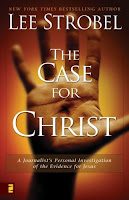
The Case for Christ

Book: The Case for Christ
Author: Lee Strobel

I’ve been meaning to read this book for a while, actually so long I think I was a Christian when it was on my to read list, (I need not spell out the irony of me finally reading it as an agnostic). Many Christians hold Lee Strobel as one of their champions of reason. He is a very smart guy, and from what I can tell he seems like a pretty genuine guy too. I love watching his faith under fire series in which he gets speakers from all across the board to battle it out. I also think he makes for a pretty fair moderator. As a Christian I used to love hearing his testimony of how he came to faith through this long journey of weighing up the facts and deep investigation. He sounded so convincing!

The book starts out in this fashion. Lee begins with his own personal journey of faith and how he became a Christian. Lee, having experience as a journalist is a very persuasive writer. Lee made some statements at the beginning of this book that set things up to be quite promising. It was shaping out to be a good read! I actually had a lot of fun at the beginning of this book, I was enjoying reading some of the answers from top Christian scholars and I thought Lee was asking some really good questions, sometimes even surprising me with a question I didn’t even think to ask myself!

However at about the half way mark, I began to find the book quite dry. I liked it, I was having fun with it, but the answers from the evangelical Christian scholars were all beginning to sound like broken records. Some of the arguments being put forth by some scholars have already been refuted by other prominent scholars. It was also around this point I had realised Lee had only interviewed Christian scholars with an apologetic purpose. I was after a fresh perspective, an argument from a different side, maybe a more liberal Christian perspective or even a secular scholar, someone with a little less theological and emotional baggage that could possibly get in the way of deciphering truth from the gospels and other historical sources. But so far Lee seemed to be avoiding the opposition which made me wonder.

It was when I got to chapter 6 “The rebuttal evidence” I thought things might start to heat up. He begins the chapter with his usual real life court case story and then proceeds to talk a little bit about the Jesus seminar; a mixed group of scholars who don’t agree with the conservative literal interpretation of the gospels that Lee is so desperately trying to prove is true. Here is how Lee starts this chapter:

“Now that I had heard powerfully convincing and well-reasoned evidence from the scholars I questioned for this book, I needed to turn my attention to the decidedly contrary opinions of a small group of academics (the Jesus seminar) who have been the subject of a whirlwind of news coverage... ” Page 111

“But I wanted to go beyond the headlines and to unearth, as commentator Paul Harvey likes to say, “the rest of the story”...” Page 112

I remember thinking to myself “awesome”! Now we finally get to hear from scholars that have different opinions. Who might he interview I wonder, seeing how he’s talking about the Jesus seminar, I wonder if it’s going to be John Dominic Crossan? Or maybe even Robert Price? I’ll tell you who it was... neither! Lee in his built up speech about hearing from those who oppose the conservative Christian view of biblical scholarship goes to interview yet ANOTHER evangelical Christian scholar who is well known for defending scholarship from the “heretical” Jesus seminar.

It was at this point the book began to go downhill from me. All the promises of genuine journalistic enquiry into what we know about Jesus were beginning to sink lower and lower. I think I realised at this point this book wasn’t indented for sceptics who have done a little research on both sides. This book sole purpose is to convince those who have already been convinced. Sorry Lee, I think you’re a top bloke but if your idea of genuine enquiry into truth is too interview one side’s proponents one after the other, you’ve lost me.

Although I found the book very one sided, let’s remember that Lee is an author. Authors don’t write books that no will buy. They are usually aimed at a specific targeted audience. But the problem I have with this book is it’s presented as an honest, open journey for truth when it shows clear signs it isn’t. The obvious being his lack of interest in alternative views, but more subtly the language he chooses to use. On many occasions I caught Lee phrasing a sentence that seemed quite odd for someone who is supposedly on a search for genuine truth. For example, at the beginning of chapter 6, he refers to the Jesus seminars views as “troubling and wildly publicised”. Why would someone on “a quest for truth” who according to page 14 is “setting aside my self-interest and prejudices” find an alternative view “troubling”?

Lee has extensive knowledge of the legal system and how court cases work, knowledge he acquired through his years as a journalistic investigator. He often refers to real life stories that have taken place in a court to use as a type of metaphor to set up his interviews:

“In this quest for truth, I’ve used my experience as a legal affairs journalist to look at numerous categories of proof...These are the same classifications that you’d encounter in a courtroom. And maybe taking a legal perspective is the best way to envision this process – with you in the role of a juror.” Page 15

Well the most obvious problem I see with the analogy of a court case is that Lee fails to interview any scholars or sceptics that have different points of view to the ‘experts’ he’s interviewing. This is rather like having a court case in which we only hear from the defence and not the prosecution (or vice versa). Does that sound fair? Does that sound like someone who is genuinely after truth?

But I refuse to fall prey to the same crime of ignoring information I’m accusing Lee of, so here is a response I’ve found from Lee on why he didn’t interview any liberal scholars with alternative views in his book, make of it what you will. (I recommend reading the comments too):


Overall I recommend this book to anyone who is interested in biblical scholarship. It’s at best a good collection of the arguments from one particular side of the spectrum. But don’t be swayed by Lee’s provocative writing style, one only needs to take a step back and look at the book as a whole too see this wasn’t a genuine search for truth. There is always another side to the story. If you’re going to read this book than I recommend you follow it up with Misquotting Jesus by Bart D Ehrman, Jesus: A revolutionary biography by John Dominic Crossan, Jesus for the non religious by John Shelby Spong or for a direct response point by point, The case against 'the case for Christ' by Robert M Price. This will give you a far broader perspective of biblical scholarship and open your mind to a number of different possibilities. Then you will truly be able to, in the words of Lee, “reach your own verdict”.


Thursday, August 19, 2010

The End of Faith

Book: The End of Faith
Author: Sam Harris

Sam Harris is one of my all time favourite authors/speaker/thinkers. I think I’ve seen every debate he’s ever been in and every time I do I’m blown away by his intelligence and his intellectual integrity. I was very impressed after reading his other book “Letter to a Christian nation” and the end of faith has been on my must read list for quite some time. I like Sam’s work so much I was willing to buy this book instead of my usual poor man’s trip down to the library, although this act didn’t come without a price.

The first time I bought this book, I was planning to read it on my long plane journey to America, which unsurprisingly I did very little as I was distracted by the on flight entertainment system (mainly Tetris). While I was in my hotel room, I happened to leave the book on the bench in what I thought was a very safe (yet oddly placed) plastic container. As it turns out this was a recycling bin and the maid, bless her little heart, thought it right to throw away this perfectly new looking book.

It took me a while, but I finally built up the courage and self esteem to bring myself to spend another twenty or so dollars for another copy of the book. This time I took the book with me to a wedding in Greece. Again very little of the book did I actually read on the plane (dam you Tetris!) and as I was about to step foot off the plane I suddenly realised I had left the book tucked away in my seat pocket. So I barged my way through the oncoming traffic of people and was lucky to retrieve the book that I’ve had to buy twice now. It would seem that the powers that be did not want me reading this book, BUT besides the obvious signs from God, I read it anyway. I’m thankful to say I haven’t been scorched in a freak lighting storm... yet!

The title of the book comes across quite aggressive, “the end of faith”, and If me being quite a liberal open minded guy when it comes to faith and spirituality found it so, I can only imagine how those who hold some sort of religious faith might feel about it. I imagine this title would turn them away immediately, which is a shame because this book makes a lot of good points aimed directly at people who hold strong religious convictions. If the only people reading this book are atheists, agnostics and men and woman of the secular persuasion, then I think a lot of what Sam has to say in this book goes to waste.

The first two chapters of the book were so far in my short journey of intellectual pursuits, the best two chapters I have ever read about understanding the concept of belief, what beliefs are and why we believe certain things. This is probably aided by the fact Sam has a Ph.D. in neuroscience. The way in which Sam explores belief, religious belief especially, and lays it out on the table seems both wonderfully insightful and painfully obvious:

“It is time we recognized that belief is not a private matter; it has never been merely private. In fact, beliefs are scarcely more private than actions are, for every belief is a fount of action in potentia. The belief that it will rain puts an umbrella in the hand of every man or woman who owns one. It should be easy enough to see that belief in the full efficacy of prayer, for instance, becomes an emphatically public concern the moment it is actually put into practice: the moment a surgeon lays aside his worldly instruments and attempts to suture his patients with prayer, or a pilot tries to land a passenger jet with nothing but repetitions of the word “Hallelujah” applied to the controls, we are swiftly delivered from the provinces of private faith to those of a criminal court.

As a man believes, so he will act. Believe that you are the member of a chosen people, awash in the salacious exports of an evil culture that is turning your children away from God, believe that you will be rewarded with an eternity of unimaginable delights by dealing death to the infidels - and flying a plane into a building is scarcely more than a matter of being asked to do it. It follows, then, that certain beliefs are intrinsically dangerous. We all know that human beings are capable of incredible brutality, but we would do well to ask, what sort of ideology will make us most capable of it?...”

Sam argues in the book that the we need new rules of conversation when talking to those who are convinced by things through unjustified beliefs, or “faith”. He uses Islamic fundamentalism to back up his arguments. The rise in Islamic fundamentalism is one that has affected the entire world. For those of us in the west, no longer is it something we can just pass off as something happening far away and not worry about it, but over the past couple of years as we’ve seen on our televisions and our newspapers is something that is beginning to trespass ever more dangerously in our lives. Sam attacks not only fundamentalist’s beliefs in his book, but religious moderates as well:

“Of course, people of faith fall on a continuum: some draw solace and inspiration from a specific spiritual tradition, and yet remain fully committed to tolerance and diversity, while others would burn the earth to cinders if it would put an end to heresy. There are, in other words, religious moderates and religious extremists, and their various passions and projects should not be confused. One of the central themes of this book, however, is that religious moderates are themselves the bearers of a terrible dogma: they imagine that the path to peace will be paved once each of us has learned to respect the unjustified beliefs of others. I hope to show that the very ideal of religious tolerance born of the notion that every human being should be free to believe whatever he wants about God is one of the principal forces driving us toward the abyss.”

I understand exactly where he is coming from and agree with him to an extent, but when I think about the idea of crushing religious moderates, I think of all my dearest and closest friends who hold to a religious belief, the kind of people that wouldn’t hurt a fly. I think of all the honest and sincere people of the world that are inspired to do good through their personal faith and religious beliefs. I am currently at a deep conflict within myself when it comes to “fighting” religion. Yes we can all agree that fundamentalism is a genuine threat and problem to our society and to the freedom of the standard of life we love so much. We should oppose this kind of black and white thinking with everything we’ve got. But do religious moderates really fuel this fundamentalism? Don’t they oppose fundamentalism just as much as those who oppose religion entirely. Should something that inspires someone to become a better person and build greater feelings of love and tolerance towards fellow human beings really be thrown in the garbage heap with radical fundamentalism? Isn’t that common ground that believers and non believers such as myself can come too?

The final chapter of the book and the epilogue were by far my favourite. Sam unlike a lot of outspoken atheist or agnostics is not afraid to explore spirituality and take ever so careful steps into trying to understand the mystical and spiritual experiences that so many have. In his last chapter of the book Sam explores meditation and the value of spiritual experience, although he tries so very hard not to use the word spiritual, instead opting for a much more liberal term “mysticism”. I really enjoyed this book and I recommend it to everyone, instead of explaining my conclusion of the book I will simply share the last paragraph of Sam’s epilogue with you, I think it sums up the book wonderfully and if any one wishes to know more they need only to read the book.

"...Man is manifestly not the measure of all things. This universe is shot through with mystery. The very fact of its being, and of our own, is a mystery absolute, and the only miracle worthy of the name. The consciousness that animates us is itself central to this mystery and the ground for any experience we might wish to call - spiritual. No myths need be embraced for us to commune with the profundity of our circumstance. No personal God need be worshiped for us to live in awe at the beauty and immensity of creation. No tribal fictions need be rehearsed for us to realize, one fine day, that we do, in fact, love our neighbours, that our happiness is inextricable from their own, and that our interdependence demands that people everywhere be given the opportunity to flourish. The days of our religious identities are clearly numbered. Whether the days of civilization itself are numbered would seem to depend, rather too much, on how soon we realize this.”

Monday, June 28, 2010

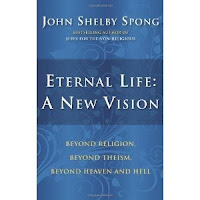
Eternal life: A new vision

Book: Eternal Life: A New Vision
Author: John Shelby Spong

In his latest book, Eternal Life: A New Vision, Spong takes you on a deep personal journey through his experiences with friends and family, and his intellectual journey on the subject of death. When reading about his life you get the sense of a man who has been through a lot. Having lost a wife, a father at a young age and many close friends, Spong is a man who definitely qualifies as someone who has had extensive experiences with death all his life.

Before reading this book I had previously only read one other book by Spong titled, "Jesus for the non religious" which I found fascinating, insightful and liberating. For those who don’t know much about Spong, here is a short video clip to get a brief idea on some of his views:


When I picked up this book I had very high hopes and expectations. While not exactly what I expected, I’m happy to say he didn’t disappoint me. I am a huge fan of John Shelby Spong and admire the man immensely. I relate a lot to his personal struggles with religious convictions and have learned a lot from the conclusions that he has drawn from a long experienced life.

He begins the book by telling his audience of his personal life journey of where his faith has lead him over the years, and his reasons for writing the book. Right from chapter one he gives us his position on the question of life after death, which he confesses is a very affirmative yes! But if you want to find out why he believes there is life after death, you will have to read to the very end of the book.

What I found most valuable from this book was not necessarily his ideas or conclusions about life after death, but his journey through religion and his life experiences with dying loved ones. I think he has a lot to share through his life story and has great insights into what he would call “the human experience”. I also really liked his critic of organised religion:

“That is the great sin of organized religion. Organized religion seeks to turn us inward upon ourselves. It binds us into a world marked by enormous limitations. Organized religion always divides the world into warring camps. It separates the followers of “true religion” from the followers of that which is judged to be false religion. It separates true believers from heretics, the clean from the unclean, the saved from the unsaved, the baptized from the unbaptised, and the circumcised from the uncircumcised”

I must admit I was a little disappointed in the way he explained (or lack of) his reasoning behind his belief in a life after death. I personally found it a little unclear and unjustified, which was a bit frustrating since he was so convincing in the beginning of the book. I also felt the book didn’t really have enough to do with exploring life after death. Much of the books content has to do with his personal journey through religion and his discoveries of what we already know about natural history.

But all in all i thought it was a great book and definitely worth a look at for those interested in the topic of life after death and who are after a fresh new perspective in the 21st century. Gotta love the Spong!